GPT-6 Astra — the new ChatGPT model that does the work for you

GPT-6 Astra — the new ChatGPT model that does the work for you
On September 3, 2026, OpenAI released a new version of the technology behind ChatGPT. It's called GPT-6 Astra, and the important part isn't that it answers questions better — it's that it can sit down at the computer and carry out tasks for you.
From answering to doing
Until now, AI tools have mostly been good at answering. You ask, you get a suggestion, and then you do the actual work yourself.
Astra is built for the next step. It can click around in programs and on websites on its own: fill in a form, add a new customer to your CRM, pull prices from five suppliers and put them together in a document.
That was possible before too, but it was slow. And that's where the real change lies: in OpenAI's own tests, Astra handles the same tasks in roughly half the time as the previous version — around 40 minutes instead of 75.
It sounds like a technical detail, but it's exactly what decides whether something becomes genuinely useful. An assistant that's slightly smarter but just as slow changes nothing about your working day. One that does the same job in half the time suddenly makes it reasonable to hand over the boring tasks while you do something else.
What does it cost?
If you use ChatGPT as normal, Astra is included in Plus, Pro, Business and Enterprise. You don't pay anything extra. One detail if you're on Enterprise: the model is switched off to begin with and has to be enabled by whoever administers your account.
If instead you're building your own solution that talks directly to OpenAI, you pay per amount of text sent back and forth. There, Astra costs roughly twice as much as its predecessor.
But don't fixate on the price tag. Astra needs considerably fewer words to solve the same task — in one test around 65 percent fewer. What you should compare is what a finished task costs, not what a single word costs.
Is it best at everything? No
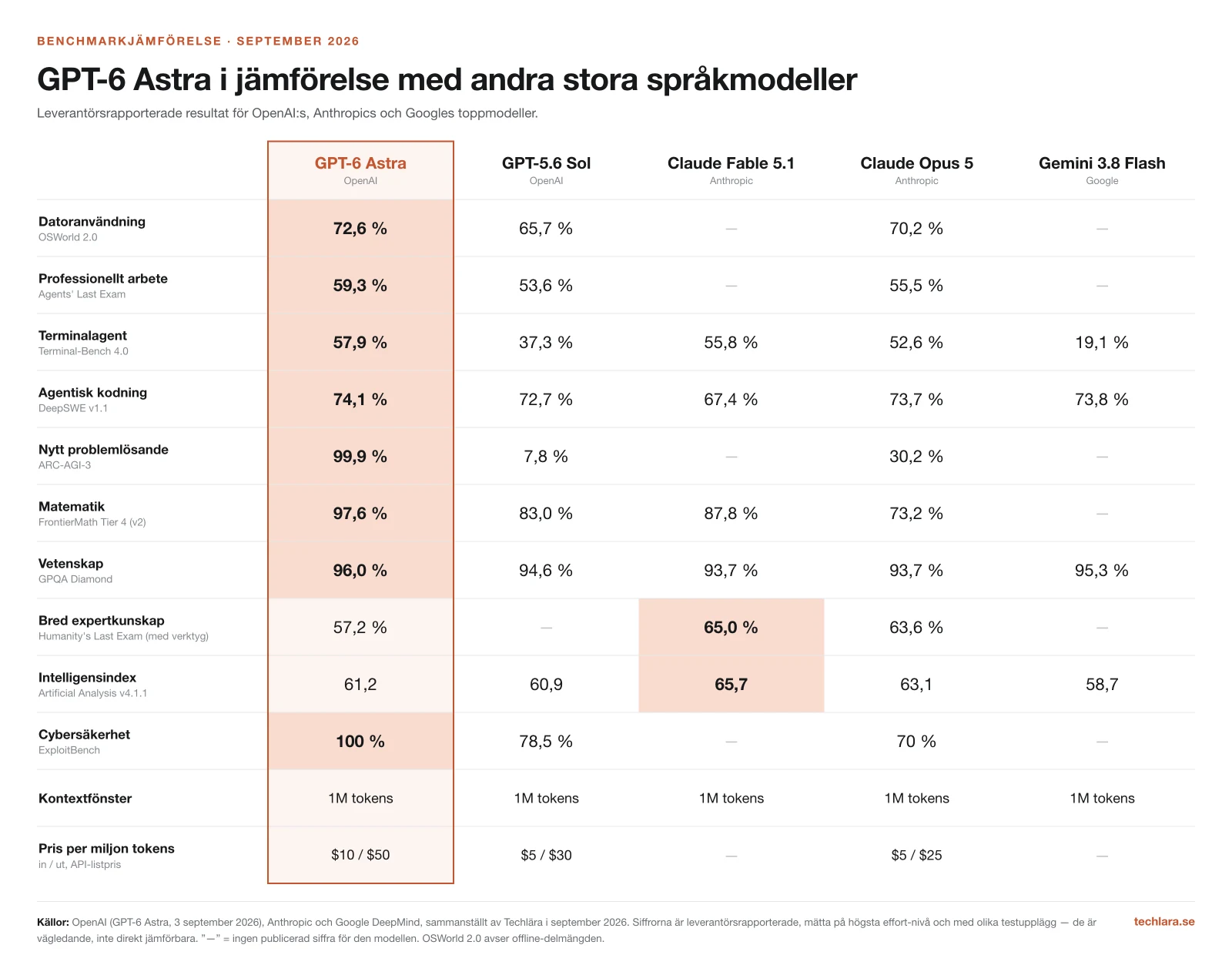
Astra clearly leads when the AI has to do things: work inside programs, keep track of many steps in a row and handle a lot of information at once.
But when it comes to knowing a lot and reasoning broadly, Anthropic's Claude is still at least as good, and ahead on some tests. Plenty of people who work with these tools daily keep both running and pick per task. We've covered the other side of the table in our guide to Claude.
If you want the numbers behind it, they're in the table below. You don't need to understand every row — the pattern is the point: Astra in the orange column leads on the practical tasks, Claude on the knowledge-heavy ones.
One thing to know before you let it loose
Astra is good enough at finding security holes in software that OpenAI has added extra safeguards. In practice you notice this in two ways:
- It refuses certain tasks involving breaking into systems, even when your intent is good.
- It can stop in the middle of a job and ask you to approve the next step.
If you're sitting in ChatGPT, that's usually just a prompt to click away. But if you're building something meant to run entirely unattended, you need to expect that a run can be interrupted — otherwise it sits there stalled without anyone noticing.
What we'd do
- Don't switch just because it's new. If you mostly write text and ask questions, the cheaper models are plenty. We cover what the cheaper tiers can do and cost in GPT-5.6 Sol, Terra and Luna.
- Astra earns its price when the task has many steps. That's when the time saved becomes real.
- Test it on a real task you do every week. Time it before and after — that's the only way to know whether it pays off for you.
- Start where a mistake is easy to spot. Don't have it run something completely unsupervised from day one.
If words like model and prompt still feel vague, we cover the basics in what an LLM is. And if you want to understand what "AI that carries out tasks" means in practice, we've written about AI agents and how they work.
If you want help deciding which model fits you — and building the thing that runs it — that's what we do as an AI consultant.
Frequently asked questions
When was GPT-6 Astra released?
On September 3, 2026. It's available in ChatGPT if you have Plus, Pro, Business or Enterprise, and for companies building their own solutions also through OpenAI, Microsoft Azure and AWS Bedrock.
What does GPT-6 Astra cost?
If you use ChatGPT, it's included in Plus, Pro, Business and Enterprise at no extra cost. If you build your own solution you pay per amount of text sent back and forth, and there Astra costs roughly twice as much as its predecessor. At the same time it needs clearly fewer words to solve a task, so compare what a finished task costs rather than the price per word.
What can GPT-6 Astra do that earlier models couldn't?
It can work on your computer for you instead of just answering: fill in forms, update records in a CRM, look up information on the web and put it together. Above all it does this quickly — in OpenAI's own tests, in roughly half the time compared with the previous version.
Is GPT-6 Astra better than Claude?
It depends on the task. Astra is best when the AI has to carry things out: work inside programs, keep track of many steps in a row and solve problem types it hasn't seen before. Anthropic's Claude is still at least as good at broad knowledge questions and deeper reasoning. Plenty of people who use these tools daily keep both running and pick per task.
Can you trust Astra to finish a task?
Usually, but not always. OpenAI has added extra safety checks, and they can make the model stop in the middle of a job and ask you to approve the next step. In ChatGPT that's just a prompt to click away. If you're building something meant to run unattended, you need to plan for a run being interrupted.