Mixture of Experts — how the technique makes Mistral faster and cheaper

Mixture of Experts — how the technique makes Mistral faster and cheaper
There is a trick inside modern AI models that almost nobody outside developer circles talks about, yet it decides what you pay every time you ask a question. It is called Mixture of Experts, and French company Mistral AI was the first to make the technique popular. Today it is used in nearly every large AI model — here is what it does, and why it matters for a smaller business.
First: what is Mistral AI?
Mistral AI is a French AI company, founded in Paris in 2023 by researchers who previously worked at Google DeepMind and Meta. They are Europe's clearest answer to OpenAI and Google, and they are known for two things.
The first is Le Chat — their chat service, free to use and a direct equivalent to ChatGPT. We put it up against four competitors on a real work task in our comparison of AI chatbots, and it won. The answer arrived in under a second.
The second is that Mistral releases many of its models freely. Anyone can download them and run them on their own hardware, with no subscription. For a European company handling personal data that matters in itself: run the model yourself, or with a European provider, and your data never leaves the EU. We have covered that whole world in open source LLMs 2026.
But the most interesting thing about Mistral is how the models are built on the inside.
What is Mixture of Experts?
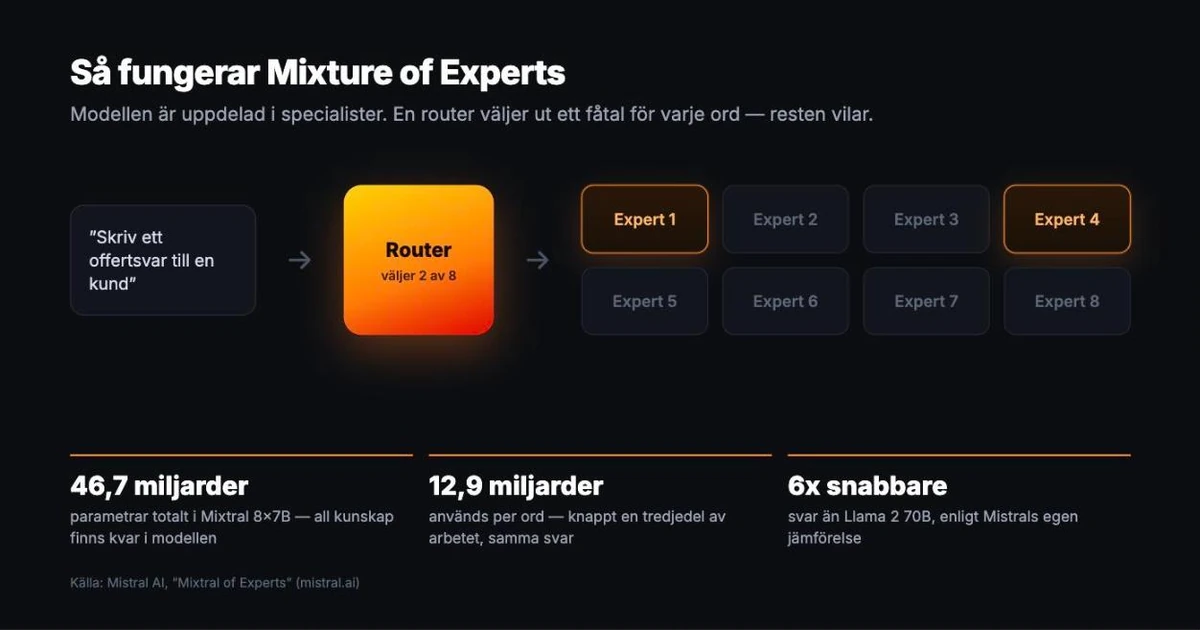
Mixture of Experts means the AI model is split into a number of specialists, and only a couple of them are switched on for each word it writes. The rest sit idle.
Picture a consulting firm with eight employees. In the old kind of AI model, all eight read every email that comes in, think it over, and each contribute to the answer. The result is good — but it costs eight people's working time for every single email.
In a Mixture of Experts model, there is someone at the front desk instead. She reads the question, sees that it is about contracts, and passes it to the two people who know contracts. The other six carry on with their day. The firm still holds all of its knowledge — but the bill for that email came to a quarter of the size.
The receptionist is called a router, and it is a small sorting function inside the model. Nobody told it which expert knows what. It worked that out on its own during training.
The numbers behind it: Mistral's Mixtral 8x7B
Mistral's Mixtral 8x7B is the clearest example, and it is still the textbook case whenever the technique needs explaining.
The model has eight experts and 46.7 billion parameters in total. Parameters are simply all the small settings the model tuned during training — the more there are, the more it knows. But for each word it writes only two experts are engaged, which corresponds to 12.9 billion parameters. Barely a third of the work, with none of the knowledge lost.
The result, according to Mistral's own measurements: the model answers roughly six times faster than Meta's Llama 2 70B, a model in the same class, and still gives answers that are at least as good. The licence is free on top of that — anyone may download the model, modify it and use it commercially.
Four benefits of Mixture of Experts
- You pay for a fraction of the work. The price of an AI answer follows, in practice, how much compute it consumes. Engage a third of the model instead of all of it, and the cost drops accordingly. Run a thousand invoice summaries a month and that is where the difference shows up for real.
- Answers arrive faster. A chatbot on your website that answers in two seconds gets used. One that answers in twelve does not. Waiting time is the most common reason an AI tool quietly stops being used in an office.
- Models can grow without getting more expensive. For an ordinary model to know more, all of it has to get heavier. With Mixture of Experts you add more specialists instead — the knowledge grows, but the work per word stays put. That is why nearly every large model today is built this way, DeepSeek and Qwen included.
- Running your own model becomes realistic. A model that only uses a third of itself at a time needs reasonable hardware. That is the difference between "we would need a server room" and "it runs on a rented server in Frankfurt".
Why almost every model is built this way now
When Mistral released Mixtral at the end of 2023, doing this so openly was unusual. Today it is the rule rather than the exception among the largest models.
Chinese company DeepSeek took the technique furthest: their large model has around 671 billion parameters in total but uses only about 37 billion per word. That is roughly one twentieth. It goes a long way towards explaining how DeepSeek could offer top-tier answers at a fraction of what the American models cost — and why AI prices fell so quickly during 2025. Alibaba's Qwen and Meta's Llama have gone the same way.
GPT-4 was reported early on to be built on the same principle, although OpenAI has never confirmed it. None of the big providers say exactly what their models look like inside any more, but the pricing tells the story: AI has become dramatically cheaper per question, and Mixture of Experts is one of the main reasons.
The catch: one thing the technique does not solve
Memory. Even though only two experts are working, all eight have to be loaded and ready to be called in. The model does the arithmetic of a small model but takes up the space of a large one.
In practice that means Mixtral 8x7B is fast, yet still too heavy for an ordinary office computer. You need a machine with plenty of memory, or a rented server. The speed is free. The space is not.
It is also worth knowing that the benefit is largest when many questions need answering. If you ask ten questions a day, the technique under the hood makes no difference — a normal subscription is simpler and cheaper.
Mistral or ChatGPT — which suits you?
The short answer: it depends on what you are doing.
- Writing text, summarising meetings, thinking out loud. Stay with ChatGPT or Claude. The ecosystem is broader, and for a handful of users a month the price difference is not worth the trouble.
- Many questions, the same kind of task, every day. Do the maths on Mistral. Volume is where Mixture of Experts pays for itself.
- The data must not leave the EU. Then Mistral is often the simplest answer: a European company, servers in Europe, and models you may download and run yourself.
- Just want to try it. Le Chat is free at chat.mistral.ai. Ask the same question there as in ChatGPT and compare — it takes five minutes.
How to test it in fifteen minutes
You need neither a developer nor a budget to form an opinion:
- Take a task you already do often. A quote template, an answer to a common customer question, a summary of meeting notes.
- Run the same task in Le Chat and in ChatGPT. Paste in exactly the same text in both. Time the answers and judge the quality yourselves — not from a leaderboard.
- Do the maths on volume. How many times a month would you run this if it worked? If the answer is "a handful", a normal subscription is enough. If the answer is "hundreds", it is worth looking closely at running your own model.
What should you take away?
Mixture of Experts is not a marketing term but a concrete way of making AI cheaper to run. For anyone buying AI it means three things: a lower price per question, a shorter wait, and a realistic chance of running the model on your own ground.
If words like model and parameters still feel vague, we cover the basics in what an LLM is. And if you want help working out whether your own model pays off in your case — and building the thing that runs it — that is what we do as an AI consultant.
Frequently asked questions
What is Mixture of Experts?
Mixture of Experts (MoE) is a way of building AI models where the model is split into several specialists, and only a couple of them are used for each word it writes. A small sorting function called a router picks which ones. The model keeps all of its knowledge but performs only a fraction of the work, which makes answers both faster and cheaper.
What is Mistral AI?
Mistral AI is a French AI company founded in Paris in 2023 by researchers from Google DeepMind and Meta. They run the chat service Le Chat, which is free to use, and release many of their language models freely so anyone can download and run them on their own hardware. The company is Europe's largest challenger to OpenAI and Google.
How many parameters does Mixtral 8x7B have?
Mixtral 8x7B has 46.7 billion parameters in total, but uses only around 12.9 billion of them for each word it writes. That is because the model has eight experts and engages two at a time. According to Mistral's own measurements it delivers answers roughly six times faster than Meta's Llama 2 70B.
Is Mistral better than ChatGPT?
Not in general — it depends on the task. ChatGPT has a broader ecosystem and more features, while Mistral is faster and cheaper per question and is run by a European company with servers in the EU. In our test of five chatbots on the same task, Mistral Le Chat won, mainly on response time. If you run many questions of the same type, or need your data to stay in Europe, Mistral is often the better choice.
What are the drawbacks of Mixture of Experts?
The biggest one is memory. Even though only two experts work at a time, all of them have to be loaded and ready, so the model does the arithmetic of a small model but takes up the space of a large one. Mixtral 8x7B is therefore too heavy for an ordinary office computer and needs a machine with a lot of memory or a rented server. The benefit also only shows up at volume — at a few questions a day you will notice no difference.
Can you use Mistral for free?
Yes. The chat service Le Chat is free at chat.mistral.ai and is also available as an app. On top of that, several of Mistral's models are freely downloadable under an open licence, which means you may run them on your own hardware without paying a licence fee — you only pay for the computing power.