Deep Research: What It Is and How to Use It


Deep Research: What It Is and How to Use It
Deep Research is a mode in AI tools where the model plans, searches the web, reads many sources and returns a report with citations, instead of answering straight away in the chat. You ask a broad question and get a briefing a few minutes later. OpenAI launched it in ChatGPT in February 2025, and Google, Anthropic, Perplexity and Microsoft now have equivalents. Here is how it works, how the tools differ and when it is worth using.
What is Deep Research?
Deep Research is an agentic feature. Ordinary chat answers in seconds, often from the model's memory. Deep Research works like a research assistant: it breaks the question down, searches, reads, searches again and then writes up the result with links to its sources. It usually takes minutes and replaces work that would take a person hours.
It is the same way of working that makes an AI agent something other than a chatbot, and it was one of the first agent features ordinary users got access to.
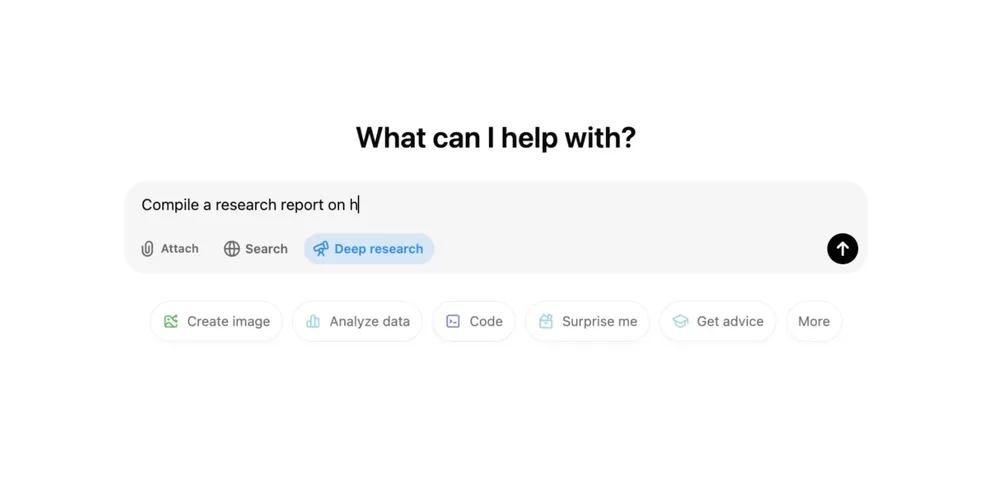
How does Deep Research work?
- You ask a broad question, such as "What does the market for EV chargers in Sweden look like, and who are the players?"
- The model plans, and may ask a follow-up to understand what you want.
- It searches and reads a large number of pages, including PDFs, and keeps searching where there are gaps.
- It writes a report with headings and citations.
- You review it. It is a draft, not a verdict.
In later ChatGPT updates you can follow the work as it happens, limit searches to sites you trust and connect your own apps and documents. The report can be downloaded. Exactly which features you get varies by plan, so check in the tool.
Deep Research in ChatGPT
OpenAI's version is the original. It started out for Pro users only ($200 a month), but it has been widened and now also exists in a limited form on the free plan. According to secondary sources the limit is about 25 runs a month on Plus and 125 on Pro, with a lighter version once the quota runs out. That number changes often, so check the counter in ChatGPT. More on the plans in our ChatGPT guide.
Gemini Deep Research
Google's version is also called Deep Research, and Google had the name first. It needs a paid plan: Google AI Pro includes Deep Research. It fits especially well if you live in Google Workspace, because it can work against Gmail, Docs and Drive. Read more in our guide to Gemini.
Claude and Perplexity
Claude has an equivalent research mode in its paid plans. It is strong when the end product is a long, well-written briefing. We cover the plans in our Claude guide.
Perplexity built its search engine around cited answers and has its own deeper research mode. See Perplexity Pro: what it is and whether it is worth the money.
Microsoft Copilot also has a Deep Research feature for detailed reports.
Which one should I choose?
- You already have ChatGPT Plus: start there, it is included.
- You live in Google Workspace: Gemini, because it reaches your own documents.
- You want sources spelled out and quick answers: Perplexity.
- The end product is a long text: try Claude.
The quickest way to choose is to give two tools the same real question and compare the reports. That beats any table.
Can you trust the reports?
Treat them as a well-written draft. The tools can cite weak sources, misread a figure or draw conclusions that go too far, and they sound confident even when wrong. Open the links for anything that matters: numbers, legal points and anything going into a decision. Do not put sensitive data into a research prompt that you would not want the service to process.
If the basics are new to you, such as model, context window and hallucination, start with what an LLM is.
Frequently asked questions
What is Deep Research?
A mode in AI tools where the model independently searches the web, reads many sources and compiles a report with citations. It takes minutes instead of seconds and exists in ChatGPT, Gemini, Claude, Perplexity and Copilot.
What is Deep Research in ChatGPT?
OpenAI's version, launched in February 2025. ChatGPT plans, searches, reads and searches again before writing a report with sources. It started Pro-only but now exists in a limited form on every plan.
How long does a Deep Research run take?
Usually from a few minutes to half an hour, depending on how broad the question is. You do not get an immediate answer in the chat.
Is Deep Research free?
ChatGPT has a limited, lighter version on the free plan. Plus and Pro give more runs. Gemini Deep Research needs a paid plan such as Google AI Pro. Limits change often, so check in the tool.
Can you trust Deep Research reports?
Treat them as a draft. The model can cite weak sources or draw conclusions that go too far, so check the facts that matter against the original sources it links to.
Which Deep Research is best?
It depends on the task and what you already pay for. ChatGPT is included in Plus, Gemini suits Google Workspace, Perplexity gives clear sources fast and Claude is strong on long texts. Compare by giving two tools the same question.
Updated: 2026-10-04