What is Jev? The AI model that cannot make things up

What is Jev? The AI model that cannot make things up
A new kind of AI model has arrived that does not write a single word. Instead it answers multiple-choice questions — thousands per second, for almost nothing. It is called Jev, and for a smaller business it is interesting for one reason above all: it cannot make up answers.
First: why a model that does not write text?
Nearly all the AI you have tried — ChatGPT, Claude, Gemini — is built to talk to people. You ask a question, it writes an answer, word by word. That is why it is good at drafting quotes and summarising meetings.
But a great deal of what a business would like to stop doing by hand is not about writing. It is about choosing. Which department should this email go to? Is it a complaint or an ordinary question? Which account does this invoice line belong to? Is this product description fine to publish?
Each of those takes a person a few seconds. The problem is that there are thousands of them a month. That is exactly the kind of work that piles up in a queue nobody gets to.
Jev is the first AI model built for those decisions and nothing else. Behind it is TypeSafe AI, an American company that stepped out of stealth on 15 September 2026 with 40 million dollars behind it. Founder Diogo Almeida came from OpenAI and helped build what became ChatGPT. The name Jev is a nod to the Jevons paradox — the idea that once something becomes cheap enough, we start using it for everything.
The difference: Jev does not write, it chooses
Here is the whole point, and it is simpler than it sounds.
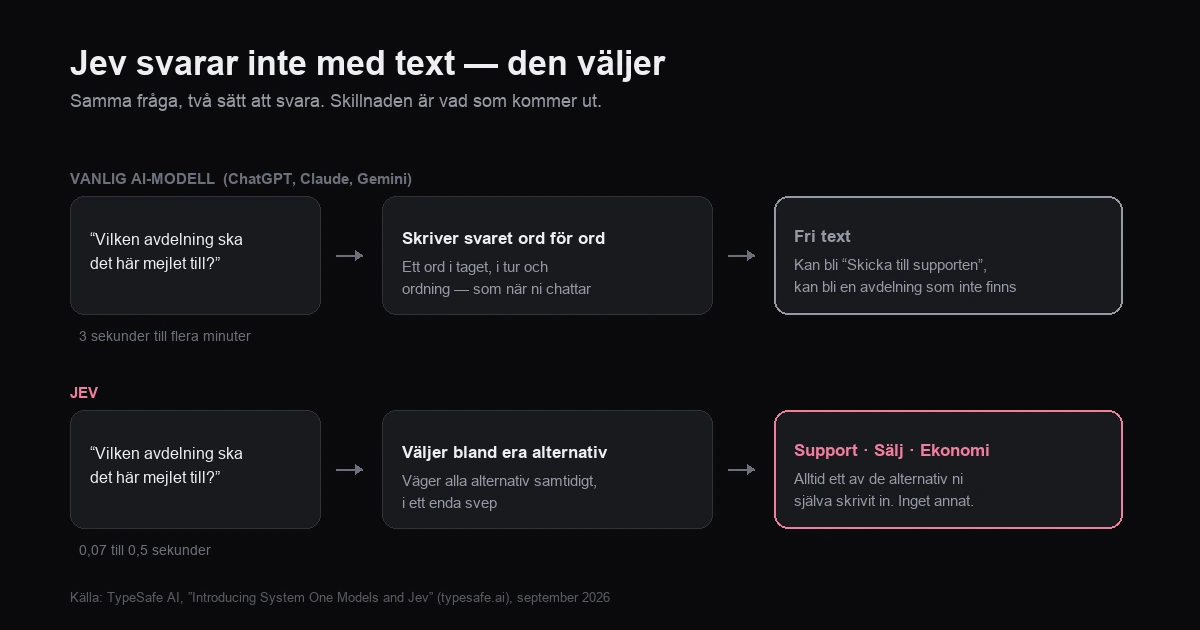
An ordinary AI model answers with free text. Ask it to sort an email and it might answer "Support" — but it might just as well answer "Forward to the customer service team", or invent a department you do not have. Somebody then has to build checks around it, and things still go wrong sometimes. This is what people call AI hallucinations: the model states something untrue with complete confidence.
Jev works the other way round. You decide in advance which answers are allowed, and the model can only give one of them. Not because it has been told to behave, but because there is no other way out. An answer outside the list is simply not possible.
It can answer in three ways:
- Pick an option from a list. Up to 255 of them — plenty of room for a chart of accounts or a product range.
- Give a rating on a scale. "How urgent is this case, one to five?"
- Answer yes or no.
And every answer comes with a confidence figure: how sure the model is. That detail is what does the most work in practice. If the model is 98 per cent sure, the system can carry on by itself. If it is 55 per cent sure, the case can go into a pile a human looks at. Where you draw the line is up to you.
Fast enough to feel like nothing
An answer from Jev takes between 0.07 and 0.5 seconds. An ordinary AI model needs anywhere from three seconds to several minutes on the same kind of task. TypeSafe puts it at 40 to 200 times faster.
That sounds like a technical detail, but it is often what decides whether a tool gets used or quietly dies. A search box that sorts results while the customer types feels like magic. The same feature with a three-second delay feels broken, and people stop using it.
What does it cost?
This is where it gets almost absurd. Sending text into Jev costs 4.2 cents per million pieces of text — in practice around five cents for a whole million words. The answers cost nothing at all. TypeSafe describes them as too cheap to be worth metering.
Ordinary AI models charge between 0.20 and 10 dollars for the same amount of text read in, and charge on top of that for what they write back — often around five times more.
What that means in practice: sorting 20 000 emails a month to the right department costs less than a lunch with Jev, and takes minutes. With an ordinary AI model the same job easily runs into the thousands and takes hours.
When is Jev worth a look for a smaller business?
The rule of thumb is simple: the same small decision, over and over.
Situations where that usually holds:
- Incoming emails and forms that need to reach the right person immediately, around the clock.
- Invoice lines and receipts that need to land on the right account.
- Product descriptions that need the right category in the web shop.
- Reviews and survey answers where you want to know which ones need a reply today.
- Checking a chatbot before the answer goes out to the customer. Jev has time to read the answer and stop anything that looks wrong, without the customer noticing any delay.
Just as important: when it is the wrong tool. Jev writes no quotes, answers no customer emails, summarises no meetings and never explains how it got there. If something has to be put into words, ChatGPT or Claude is still the answer — we put five of them head to head on the same task in our comparison of AI chatbots.
It is also worth keeping Jev and an AI agent apart. An agent does things on its own: opens programs, clicks around, sends emails. Jev does nothing at all — it answers a question. But it may very well sit inside an agent as the part that decides what the next step should be.
So find out whether it is worth anything to you
You need neither a developer nor a budget to answer that. It takes an afternoon:
- Find the pile. Which recurring decision costs you the most time right now? Emails to pass on, receipts to code, cases to prioritise. Pick one, not three.
- Write down the options. If a new colleague were doing this, which answers would they get to choose between? If you cannot get them down to a list, the task is probably not a choice but a judgement — and then Jev is the wrong tool.
- Do the volume maths. How many times a month? Below a few hundred, the technology makes no difference — an ordinary AI subscription or a simple rule will do. If the answer is tens of thousands, this is exactly what Jev was built for.
If all three fall into place you have a concrete case to test the day the waiting list opens. If they do not, you have saved yourself a project budget.
The catch: "cannot make things up" is not the same as "always right"
This is the most important part of the article, and it is easy to read past.
That Jev can only answer with your options means the shape of the answer is always correct. You will never get an invented account number or a department that does not exist. But the model can still pick the wrong option — much as a new colleague might put an email in the wrong pile during their first week.
The difference is that the error is manageable. It shows up in the confidence figure, it can be measured against real cases, and you can set a threshold for when a human should take a look. A made-up claim in the middle of a flowing paragraph is far harder to catch.
Two more things to know before getting too excited: Jev is currently available only in early access with a waiting list, and it reads text only — no images, no audio. It is a building block for people developing systems, not a service you log into and start using this afternoon.
What should you take away?
Jev is not a better ChatGPT. It is something else: a model that makes small decisions, quickly, cheaply and within limits you set yourself. Its arrival now is no coincidence — it is when the price falls below a certain level that it becomes reasonable to let AI look at every single email instead of a sample.
If the basics are still hazy, we go through them in what an LLM is, and why AI has become so much cheaper in our walkthrough of Mixture of Experts. If you would rather have help identifying which decisions in your business are actually worth automating — and building the thing that runs them — that is what we do as an AI consultant.
Frequently asked questions
What is Jev?
Jev is an AI model from the American company TypeSafe AI, launched on 15 September 2026. Unlike ChatGPT and Claude it writes no text. Instead it answers questions with predefined answers: it picks an option from a list of up to 255, gives a rating on a scale, or answers yes or no — always together with a figure for how confident it is. An answer takes between 0.07 and 0.5 seconds.
What is a System One model?
System One model is TypeSafe AI's name for an AI model built to make fast, bounded decisions rather than write text for a human. The name comes from psychology's ”System 1”, the fast and intuitive mode of thinking. Jev is the first model of its kind open to the public, currently through a waiting list.
Can Jev hallucinate?
Not in the shape of its answer. Because Jev may only return an answer from the list you defined, it is impossible for it to invent an account number or a department that does not exist — that limit is built in, not an instruction. It can, however, pick the wrong option. That shows up in the confidence figure attached to every answer, which is why you can set a threshold for when a case should be reviewed by a person instead.
What does Jev cost?
Sending text in costs 4.2 US cents per million pieces of text, which in practice comes to around five cents for a million words. The answers are free. Ordinary AI models charge 0.20 to 10 dollars for the same amount of text read in, and charge on top of that for what they write back, often around five times more.
What can a small business use Jev for?
For the same small decision over and over: routing incoming emails to the right department, placing invoice lines on the right account, categorising product descriptions in the web shop, flagging which reviews need a reply today, or checking what a chatbot is about to say before it reaches the customer. Jev is the wrong tool for anything that has to be put into words — quotes, customer emails and meeting summaries still belong in ChatGPT or Claude.
Is Jev the same thing as an AI agent?
No. An AI agent does things on its own — opens programs, clicks around web pages, sends emails. Jev does nothing at all; it simply answers a question with a predefined option. Jev can, however, sit inside an AI agent as the part that decides what the next step should be, because it is fast and cheap enough to be asked hundreds of times within a single workflow.